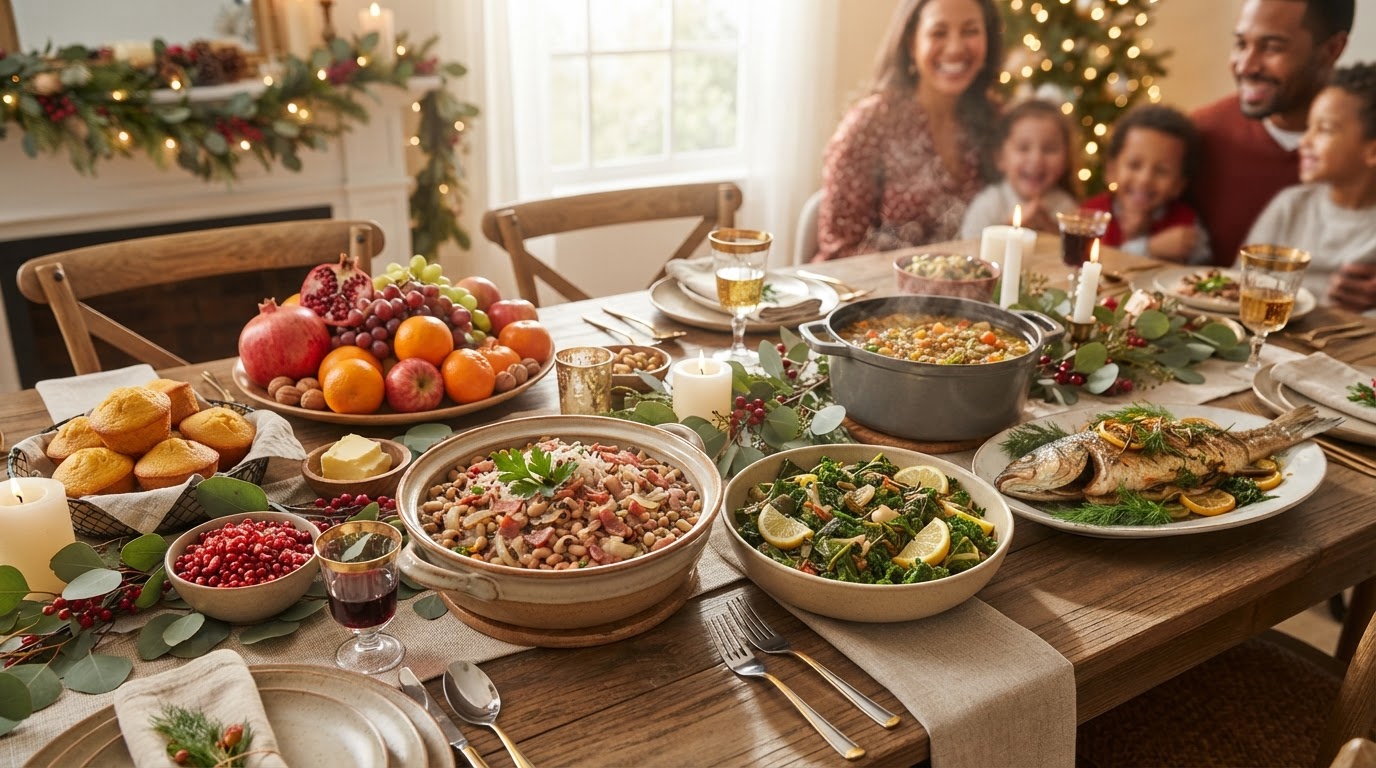
Around the world, what you eat on New Year's Eve and New Year's Day is believed to shape your fortune for the year ahead. These lucky foods share a common thread — they symbolize prosperity, longevity, or abundance, often through their shape, color, or the way they're prepared.
In Spain and much of Latin America, people eat exactly 12 grapes at midnight — one for each chime of the clock, one for each month. The challenge is to finish them all before the last bell. Sweet grapes predict a good month; sour ones warn of a tricky one.
In the American South, black-eyed peas and collard greens are the classic New Year's meal. The peas represent coins and the greens represent paper money — together, a plate of prosperity. Add cornbread for gold, and you've covered the whole currency.
In Italy, lentils are the lucky food. Their round, coin-like shape and abundance when cooked symbolize wealth. Cotechino, a rich pork sausage, often accompanies them — pork's forward-rooting motion represents progress.
In many Asian cultures, long noodles represent a long life. The rule: never cut the noodle. Dumplings, shaped like ancient gold ingots, symbolize wealth, and fish — the Chinese word for fish (鱼, yú) sounds like the word for surplus — represents abundance.
In Germany and Austria, marzipan pigs (Glücksschwein) are gifted as a symbol of good luck, since pigs have long represented prosperity. In the Netherlands, oliebollen — deep-fried dough balls dusted with sugar — are the New Year treat, originally meant to ward off a mythical winter creature.
Round foods are a recurring theme: in the Philippines, tables are laden with 12 round fruits for the 12 months. Donuts, cakes, and anything ring-shaped symbolize the year coming full circle and the continuity of life.
Whatever you eat this New Year, the tradition is less about superstition and more about intention — gathering around food with people you love, and starting the year with hope on your plate.